Friday, May 26, 2017

May 24th The Kimbell Art Museum & Louis I. Kahn Exhibit

Renzo Piano Pavillion and Kahn landscape
After spending two hours enjoying the Cowgirl Museum I returned to my motorhome to have lunch and relax in the still-shaded spot. When Roger led my tour of downtown Fort Worth he drove by the Kimbell Museum and insisted that I must go there. I’m not big on museums – generally preferring to be outside when I travel but I headed that way after lunch. The Kimbell is located in an area of downtown Fort Worth called the Cultural Center – the same area where the Cowgirl Museum, the Science and History Museum, the Amon Carter Museum, the Will Rogers Memorial Center, the Botanical Garden and a few other cultural resources are all located together.
Sloped landscape over the underground garage

The Kimbell Art Museum is a complex of modern buildings designed by Renzo Piano and Louis I. Kahn. The complex opened in 1972. The landscape that surrounds the complex is stunning with bold, angular lines and rigidly aligned trees. A few pieces of sculpture are strategically placed in the landscape.

Highly-finished concrete and light are the key ingredient in the buildings. Both Kahn and Piano were geniuses when it came to using natural light to illuminate the interior of their buildings. Inside I toured the Louis I. Kahn exhibit and learned much more than I’d previously known about the extraordinary breadth of his architectural work throughout the world.
Roof of the Piano Pavillion

Rain God Vessel, ceramic, Mexico, ca. 1100-1400

Interior of Renzo Piano building


Aligned trees in the Kahn landscape with Will Rogers tower
in the background

Bold, angular landscape detail


L'Air by Aristide Maillol in the green court

100 foot long bays

May 24th The National Cowgirl Museum & Hall of Fame, Fort Worth

Tad Lucas
When I retired from PGAdesign after 40 years I avoided a big party where old friends would say embarrassingly nice things to me. Instead I agreed to a very nice lunch with my business partners and wonderful staff. Unexpected, but very much appreciated, were several suitable and thoughtful gifts. One that I’ve used a lot is a book titled, “Off the Beaten Path” published by Reader’s Digest. I’ve read all the chapters on states I plan to drive through and a couple that I might. On page 320 I read about the National Cowgirl Museum and Hall of Fame in Fort Worth, and decided that was on my must see list.

When I left Roger and Galinda’s home I first stopped at AAA to get more paper maps to help with my orientation in the Fort Worth/Dallas metropolitan area. Once augmented with maps and a TripTik Travel Planner, I headed for the Cowgirl Museum. Arriving a few minutes before they opened I found a nice spot in the shade to park – a real prize for the southwest – for $7/all day.
Bronze cowgirl sculpture at the Cowgirl Museum,
Fort Worth, Texas

I walked around the exterior taking photos of the wonderful building details and vicariously enjoying the energy bursting from a large group of school kids waiting next door to visit the Science and History Museum. I wondered if once inside the building might burst from all that enthusiasm.

The Cowgirl Museum is very new – maybe 2 years old, so the exhibits are varied and sophisticated. My favorites were 4 or 5 holographic moving images of Annie Oakley talking and explaining things about her life. There were monitors and headphones available and a selection of recorded videos of modern day cowgirls talking about different aspects of their lives. You could ride a bucking bronco, have it video recorded and sent to your email or select a backdrop and have your photo taken in a historic cowgirl setting. Between these high-tech exhibits there were more traditional items like the clothes Cowgirls wore and how they evolved over time. Many of the exhibits were from the days of early television when Annie Oakley and Roy and Dale Evans were on TV in the 1950s. At that time the Cowgirl costumes were pretty elaborate.
Science & History museum next to the Cowgirl Museum

Annie Oakley was a star in the Wild West Show that was immensely popular not just in the US but throughout the world. One of the exhibits showed all the countries the Wild West Show visited each year for several years – it was amazing. Unfortunately, they did not permit photos of any of the exhibits so you’ll just have to take my word for it or, I recommend visiting yourself.
Detail of the Cowgirl Museum 

Self portrait while photographing the door handles

Centipede structure outside the Tech Museum

Cowgirl group photo


Mitzy Lucas Riley, trick rider for 4 decades
1924-1990. Won her first competion in 1917
at the age of 15 - Girl's Steer Riding Champ

Will Rogers complex within walking distance from the
Cowgirl Museum

May 23-24 Fort Worth - Tech Problems & Compassion

Entrance to Cleburne State Park built by the CCC
My three days spent at Possum Kingdom State Park were just what I needed. Since leaving Liz’s house I’d been on the go non-stop. I needed time to catch up with labeling photos, writing and relaxing.

I left the park in the morning and set my TomTom navigation system to Handley, Texas where my great grandparents had married and lived from 1879 – ca. 1886. While navigating the rather intense Fort Worth freeway network I lost faith that it knew where it was taking me, so I pulled off and tired, I decided to head for Cleburne State Park for the night. That evening I had difficulty connecting with Dianne on Facetime and could not get my AT&T personal hotspot to work at all. I could not connect to the internet but attributed the failure to dense tree cover and the windy conditions. 
Handley where my great grandparents lived is now a
designated Historic District that has merged into For Worth

After checking my paper maps I headed out the following morning towards Handley. I had a CGS Capital Campaign meeting scheduled for 11:00. When I arrived I plugged into my new solar powered electrical outlet, since I was not in a campsite and not connected to regular power. Starting up my laptop I found I still had no internet connection so was unable to access the conference call-in number. No problem, I simply telephoned Jane and asked if she would initiate the conference call. She did and that worked fine. But, when our meeting started an hour+ later I found that my laptop had run out of power – my solar adaptor had failed, so I was unable to access my meeting agenda and had to take notes with paper and pencil!
Jada's Boutique - one of the older commercial properties in
Handley

I was a bit distressed to find I had no source of power, my laptop was completely run down and I had no internet access. But I figured it was all temporary and would somehow fix itself so I continued with my day hobbled but not out.

I explored the Village of Handley looking for buildings that might have existed in the early 1880s. Most of the homes appeared to be built in the 1920s and 30s. I stopped to chat with a resident out tending her nice garden and asked where the commercial district was. She directed me. These buildings were clearly old but not likely from my time period. I went into one very nice paper products/wedding shop to ask about where I could learn more about the town. She directed me to Betty Cormer who sent me across the street to the antiques shop. The shop keeper suggested I check the library at TUA (Texas University at Arlington). I headed that way but after driving further than I’d anticipated from his directions I decided I’d had enough and should look for a place to spend the night.
Handley feed store - a likely candidate for my
great grandparent's era

That is when I discovered that my camping app also was not working. I tried just entering “camping” on my iPhone map function and my phone showed that I was near a campsite but it would not provide an actual map or any directions. OK, now I was stressed – nothing was working.

Roger to the Rescue
One of the nice things that happened at Possum Kingdom was that I met Roger Miller and his partner Galinda. Roger walked over to my site one evening and introduced himself. I invited him to sit down and the two of us enjoyed a varied and rich conversation for about an hour.  The next day I was about to walk over to ask for a suggestion of where to stay in Fort Worth when Roger was back. This time we talked for about an hour and a half. Roger is not what you might envision for a native Texan. He is as liberal as I am, maybe more so, and would fit in perfectly in Oakland or Berkeley. I enjoyed his company so when he left and said, “let me know if you need anything while you are in Fort Worth – feel free to come and stay in our guest room”, I accepted it as a genuine invitation. Of course at that point I had no expectation that I would need anything. But here I was struggling with my technology, tired and with no place to stay, so I called Roger and just said, “I need help”. He responded without hesitation giving me directions to his home.
The train came to Handley in 1876. My great grandparents
James and Carrie Pattillo were there by 1879

As soon as I arrived he connected me with the internet and tried to troubleshoot my tech problems. When that failed I called Computer Courage in Berkeley who provided a simple solution – reboot my phone. I had rebooted my laptop repeatedly – a cold and hard boot but neither helped. It never occurred to me to reboot the phone but CC explained that since I’d moved to a new location I needed to let the phone seek different satellites to make my connection. I did what they suggested and bingo, everything worked and I was back in business.

Roger told me where I could get the power converter in the motorhome fixed and invited me to go out for dinner. I accepted insisting I would pay for the meal. Then after dinner he gave me a personalized tour of downtown. That helped to reduce my anxiety about driving through their freeway maze the next day. I camped that night in Roger and Galinda’s driveway and in the morning headed off feeling oh, so much better. Thank you Roger and Galinda.
One of the oldest homes in Handley but not from
my great grandparents era

Handley Community Park and gazebo 

Concrete stamp in Handley dated 1868. When my great grandfather
moved to Los Angeles he had a concrete contracting business.
His son, Lewis Pattillo, my grandfather and his grandson Bert,
my uncle both took up the same trade

The same train tracks in Handley are still there and in operation

A typical 1920s era Handley home


Note the wonderful live oak trees that were throughout the
neighborhood

This gate post and stone wall are one of the
few things I found in town that may be from
the time period when my family lived there.

Wednesday, May 24, 2017

May 19-22 Breckenridge & Possum Kingdom State Park

Fountain and mural in Breckenridge, Stephens County, TX
Yesterday when I turned down that dirt road to check the Clear Fork Cemetery it was about 1:00. I hadn’t had lunch so was hungry and I needed to pee. Then Scott came along and for the next few hours I couldn’t do anything about either but somehow I didn’t care. By the time I pulled into the RV Park in Breckenridge where I’d planned to spend the night, I was exhausted. It was still hot and windy. I parked, got hooked up and had to rest a bit before I could muster enough energy to fix something to eat. That night I got to experience my second southwest thunder and lightning storm – it just rocked me to sleep.
Stephens County Courthouse in Breckenridge

Friday morning I slept in then headed for the town of Breckenridge. I still wanted to find Joanna’s death certificate because I hoped it might include the names of her parents.  The courthouse is another monumental building, originally built in 1883 and replaced with the current building in 1926. I went to the City Clerk’s office where I met Jackie and Christy. Jackie explained where I needed to look. Sadly, they do not have a record of Joanna’s death but I did find a couple other Stover death records that I did not recognize but figure they must be related somehow, so I made copies. Then I spent a couple hours scanning land records for various transactions recorded by D. G and Nannie Stover.
Ornate doorway from the original courthouse built in 1883

While doing this work one of the clerks was listening to a weather report. A tornado was near Abilene, Texas – about 60 miles from where we were. They seemed quite concerned so naturally I felt uneasy. Fortunately for me that tornado didn’t come our way.

I also stopped in at the Swenson Museum to find out what they might have on my family. Scott had encouraged me to check there, but even though the librarian checked several books and binders she was unable to find anything on Stovers or the Pattillos. The town of Breckenridge did not excite me as Albany had so I decided to head towards Fort Worth.
War memorial at the Breckenridge courthouse

The camping app I’ve been using brought up a few private RV Parks and one state campground – Possum Kingdom State Park. I can’t say the name was real appealing but I called anyway. The park ranger said they were full but I said I was feeling lucky and hoped a cancellation would come through. It was about 30 miles from where I was – a nice drive on county roads. When I assured them I only planned to stay one night they let me in. I found the best campsite in the whole darn place, No. 14. It’s about 25 feet from the lakeshore and the next nearest campsite is about 50 yards away. The entire campground is covered in grass and trees – mesquite, oak and juniper. It was hot when I arrived but cooled down nicely at night.
Site No. 14 was so nice I stayed for 3 days

The literature they gave me when I registered explains that the area got it name because Ike Sablosky, who was in the hide business, said, “The best source of possum hides came from hunters up in Northwest Palo Pinto County”. Ike called the area Possum Kingdom and the name stuck. So far, this is the nicest place I’ve camped and since it is the weekend and the places I’ll want to visit in Fort Worth are likely to be closed until Monday, I called the Ranger this morning to ask if I could be added to the wait list and stay another night.
Well, my Texas luck continues – I’m paid up for two more nights and happy as a possum.
These 3 ducks hung out at my site quite a lot - they weren't shy
This beautiful beetle sauntered across my table

Sunset at site No. 14 Possum Kingdom State Park

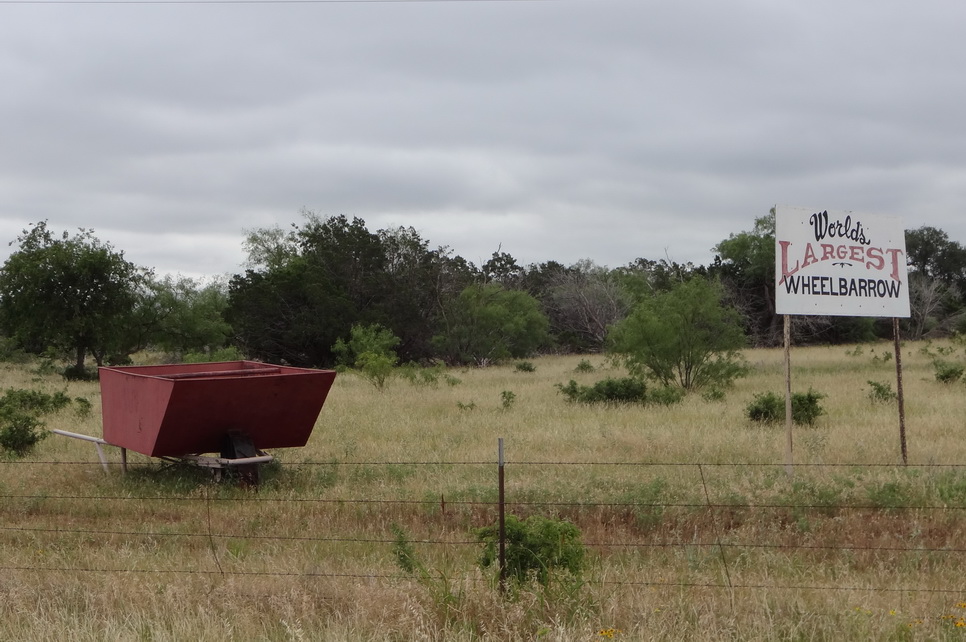
Curiosity along the road heading to the park - World's
largest wheelbarrow

Sunday, May 21, 2017

May 17th The Search for the Tipton Cemetery

D.G. and Nannie Stover Sr. home on the Brazos River,
Stephesn County, Texas
When I left Fort Griffin I was headed for Breckinridge, Texas. I had two options – go back through Albany or head north for a short distance towards Woodson and then south on Highway 183. I chose the latter and was glad I had because after driving a short ways I remembered that County Road 279 was between Highway 283, which I was on, and 183. This is important because I knew the grave of my second great grandmother, Joanna Gaines Stover, was somewhere on CR 279.

The FindAGrave website lists J.N. Stover with the correct birth and death dates along with 7 others who are buried in the Tipton Cemetery. Joanna’s daughter Sarah married Winfield Scott Tipton, so I was quite certain this was my ancestor. The only problem was that the website said the cemetery “was located on private land”. I had no idea where on CR 279 this small, historic cemetery was.
The stone over the door shows an 1886 date of construction

My plan had been to visit the county courthouse in Breckenridge in search of her death certificate and hoped that it would provide another clue. The courthouse website noted that they had death records starting in 1903. My GG Grandmother died in 1902 but that did not deter me. Plan B was to ask around town if anyone knew where the Tipton Cemetery was. Plan C was to drive up and down CR 279 and stop and ask everyone I saw.

But here I was already on CR 279. I thought I’d scope it out before I initiated plans A, B and C. A ways down the road I noticed a man in a pickup truck, I drove on and then thought, “I should have stopped to ask him if he knew where the cemetery was”. Then I noticed a sign for the Clear Fork Cemetery. The name was wrong but hum, maybe the Tipton Cemetery has two names – I’ve had that experience before in Tennessee. So, I turned down that dirt road squeezing through a narrow cattle guard, parked and was trying to open the gate when the pickup truck pulled in behind me.
The Clearfork of the Brazos River

I introduced myself to Scott Harris and explained what I was up to. Scott thought for a moment and said he did not think there were any Stovers or Tiptons buried there but he offered to help me look. First, he described two other cemeteries he knew of in the area.  One sounded just right – it was small and lucky for me Scott knew where it was, he though he knew the combination to the gate – because one of the property owner’s cattle had gotten on his property and he had to return it.  And, Scott said, “he’d always been curious who was buried there”, so off we went.

After Scott had opened the gate, he instructed me to stay behind him as we walked through the two foot high dry grass. Scott grabbed a stick and explained that, “sometimes one can encounter a rattlesnake in the grass”. I happily obeyed and stayed a few feet behind. What we were looking for was an area about twenty foot square enclosed by a rusted metal/chain link fence that was completely invisible from the dirt road. But somehow Scott led me to the hidden site. As he unhooked the “gate” I held my breath. Inside there were 8 graves. Three had headstones and 5 had “temporary” metal labels about 4” x 10”.
There were five of these metal markers. This one is for
Nellie R. Tipton 1891 - 1897

At each marker Scott brushed away the grass and I snapped a photo. And, there it was – one of the three headstones was for J.N. Stover 1826 – 1902. Scott had led me to my 2nd great grandmother. I was overjoyed. When I left Oakland, the one thing I most wanted to achieve on this trip was to find and photograph Joanna’s grave. I knew it was a longshot that I’d find it – in fact, now it feels like a miracle.
Granite headstone for Mrs. J.N. Stover Jan. 1826 - March 1902

But that’s not all. Scott told me that he’d take me to the Stover stone house just up the road. While in Albany I’d been asking everyone where the Stover ranch had been. Everyone I asked tried to help me but I didn’t have enough information to figure it out. Now Scott drove me right to it. We both got out and walked all around the building which was originally built in 1852 and expanded in 1886.  I took photos from every angle and felt great contentment. Scott said the Stover house is on a 160 acre plot of land and the story he was told is that “In the late 19th and early 20th century, our ancestors would take refuge in the basement of the Stover house during Indian raids.” I responded, “So, my ancestors sheltered yours … and now, you’re returning the favor.”

So, it turns out Scott is 67 just like me, he just retired just like me, and he’s been asked to serve on the local preservation committee as I did in Oakland a few years ago. His father started ranching there after he served in WWII and Scott hopes to pass it on to his children or grandchildren. He practices sustainable farming and explained that, “he’s not a rancher – he grows grass”. What he meant by that is that he needs to grow grass to feed his cattle. Growing grass depends on rain. Scott explained that the ubiquitous Mesquite trees suck up too much water so the responsible landowners work hard to control their spread. He pointed out his land that was covered with grass and native oak trees while others allowed the mesquite to take control.
Scott Harris at the Tipton Cemetery

Next, Scott took me to meet his father Thomas C. Harris. Mr. Harris is 90 years old, a bit frail but sharp mentally. We visited for about forty minutes and I was very happy to learn more about the Harris family history. Mr. Harris knew a lot about my Stover ancestors. When Mr. Harris’s grandparents first came to the area they lived in the Stover’s basement until their own house was built. A.W. Tipton’s granddaddy helped the Harris family build their home. In the late 19th and early 20th centuries, when Indian raids were still happening, Tom Harris’s grandparents would take refuge in the basement of the Stover house.
This is the East facing side of the house built in 1886
When I asked Mr. Harris if he knew Mule Stover I got an earful. (Note: For the full affect you need to read the next few paragraphs with a Texas accent) He started by exclaiming “Mule, he was something else!” The first story he recounted was about Mule and his cousin A.W. “Tip” Tipton. It seems Mule had a special mare that he thought very highly of. One day one of Tip’s Daddy’s Jacks impregnated Mule’s mare. Tip and Mule caught the Jack in the act and Mule was so mad they castrated the Jack. As far as Mr. Harris knows Tip’s Daddy never found out who did it.

Mr. Harris was also finally able to answer my primary question about Mule – how did he get his nickname? Well, turns out Mule could mimic the call of a braying mule. He did it so well and so loudly “you could hear him for miles”. 
Mule Stover from the Portal of Texas History website

Mule never owned a car. Instead he depended on his friends to bring him what he wanted and take him to where he needed to go. In return his buddies would come out to Mule’s place – not much more than a shack down by the river on his parent’s ranch, and they’d have drinking parties that might last for two or three days. “Mule was a great cook – he’d cook anything his friends brought out to him”.

Sometimes he’d go into Fort Worth. He’d go to a local hotel and start running up a tab – then he’d skip out. “He was ornery as hell.” On the other hand, “he was very friendly and you couldn’t keep but like him, but you couldn’t trust a word that he said.” “He was a fun guy but you couldn’t trust is character.” Mule married late in life and straightened out but didn’t have any children.  Mr. Harris then added that Mule’s sister Joanna was normal – not like Mule.
Willie R. Powers Tipton, wife of W.T. Tipton, Sr. 1899 - 1946

Before we went our separate ways I asked Scott, “Why did you follow me down that road?” He answered, “I figured anyone out here is either a poacher or lost, and whichever it is I can help with both”. Lucky for me I was not poaching. I promised to share my cemetery photos with Scott and gave him my card just in case he finds another piece of Stover history. 
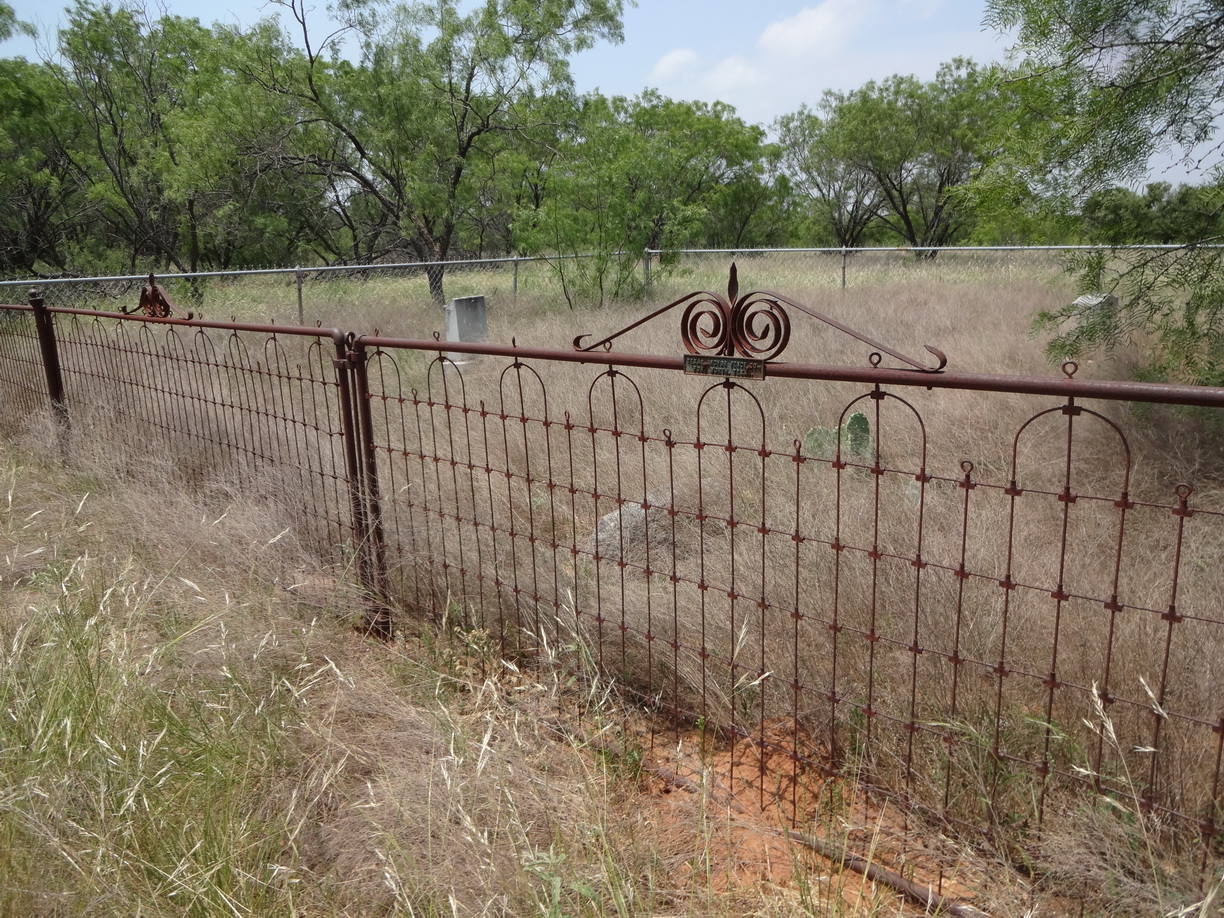
Nice detail on the cemetery fence with Mesquite trees in the background